

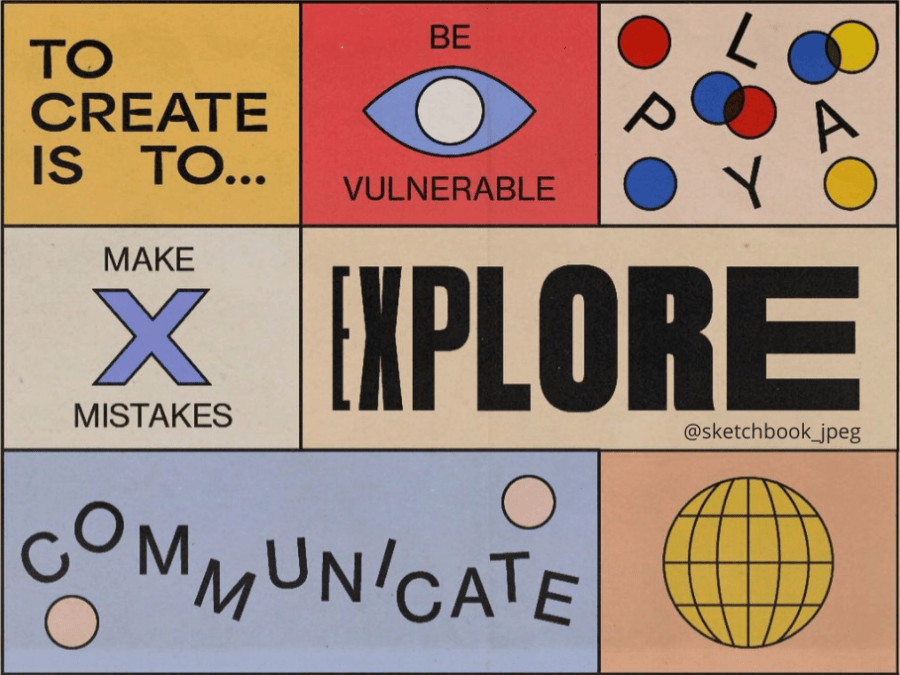
Being a creative can be a beautiful and exhilarating path to take. Nothing compares to the fulfillment of seeing what was once just an idea materialize into something tangible that you’ve poured your heart and soul into. However, for that same reason, it can also be draining.
Especially if your creative craft is more than just a hobby; if it’s what you do for a living, as a job, or even a side-hustle, it comes with the added pressure of delivering. Delivering comes hand in hand with deadlines, and deadlines don’t understand about creative blocks. In fact, they don’t give a damn about them. If anything, the added pressure they create just makes creative blocks worse. And when your creative tap suddenly shuts down, leaving you without a single drop of inspiration to drink from, who pays the bills? Who’s gonna deliver?
Whether you’re a freelancer, an artisan, a writer, CEO, or entrepreneur searching for some homespun hard-won creative inspiration, this blog post hopes to encourage you to enter your creative flow and give you a few easy guidelines that will help you create without inhibition.
So if you have been feeling a little uninspired lately, or if you are going through a creative block, I am here to give you the little push you need to tap into your creative element. And that starts with being honest with yourself.
1. Creating with honesty
The best creative work is done from the heart. When the creator and the creation are connected and in sync. When there’s a flume of truth between them.
Whether you are creating a piece of art, a piece of writing, a portfolio, or even a speech, proposition, or presentation… if you don’t believe in what you are trying to bring to life, if you don’t vibe with its nature, you will lose its power of authenticity and encounter friction.
You might not be conscious about it, but your subconscious will identify contradictions that will result in blockers of your creative process. Does that mean that you can’t do good work if you are not inspired by it? Of course not. You can still rock the project or task that a client or your boss has assigned you with, despite not feeling connected to it. But we are not talking about the output here. We are talking about the process. And in that regard, your creative process is much more likely to be ignited when your work is connected to your core.
You have probably experienced it yourself: It is more difficult to create for the sake of creating. It’s harder to be ‘in the flow’ when what you have between your hands doesn’t inspire or evoke anything within you. And although I did say we are not focusing on the output itself, let’s face it, your creation is also more likely to feel more flat and lifeless when you’re not fuelled by that creative spark.
Instead, whenever you feel blocked, try to dig in a little deeper towards the source of purpose that has taken you to create whatever you are creating in the first place. Operate from the heart. Connect with your creation. Ask yourself: What is its ‘why’? Why is it important? What does this creation mean to me? What does it make me feel? What part of me, which truth that I believe in, is being materialized here? What is its purpose? What does it express?
So the first tip to break your creative block starts with rooting your creative process in your purpose or mission. For that to happen, you must be open to be vulnerable and look inwards. It’s time to give yourself permission to create in a way that feels natural to you; a way that feels good, authentic, and true.
When you find that, you will not only find your creative spark but also your uniqueness.
2. Be open and ready to do imperfect work.
Whenever you’re about to enter your creative process, remember to leave perfectionism behind. One of the major creative blockers is rooted in the fear of imperfect work. In other words, the fear of not living up to your own expectations. I invite you to silence your inner critic and enter the creative process with curiosity instead of striving for perfection.
There will be plenty of time for edits, polishing, and iterations later. But first, you have to start ugly. And that goes for a writer’s first draft, an artist’s first strokes over a white canvas, a song’s initial empty melody, or any other piece of creative work.
Being overly critical half-way through the process will only slow you down, preventing you from finishing whatever you are working on. Trust the process. Get comfortable with the more raw version of your work and just go with it. See where it takes you.
Remember that the creative process is also a learning journey where there’s also plenty of space for you to keep on reinventing yourself.
3. Just get started.
Sometimes the most difficult thing is to get started. That is why, by all means, you just need to start.
Starting is the first step to fight that resistance coming from your doubts, fears, and procrastination habits.
If you’ve been experiencing a creative block for quite some time now, don’t expect it to just ‘fade away’. We all get sudden bursts of inspiration every now and then, but in general, inspiration doesn’t come knocking at your door without effort. There’s a certain will required in the process. As Picasso used to say, “inspiration exists, but it has to find you working”.
So start working. A hesitant and shy start is better than no start at all.
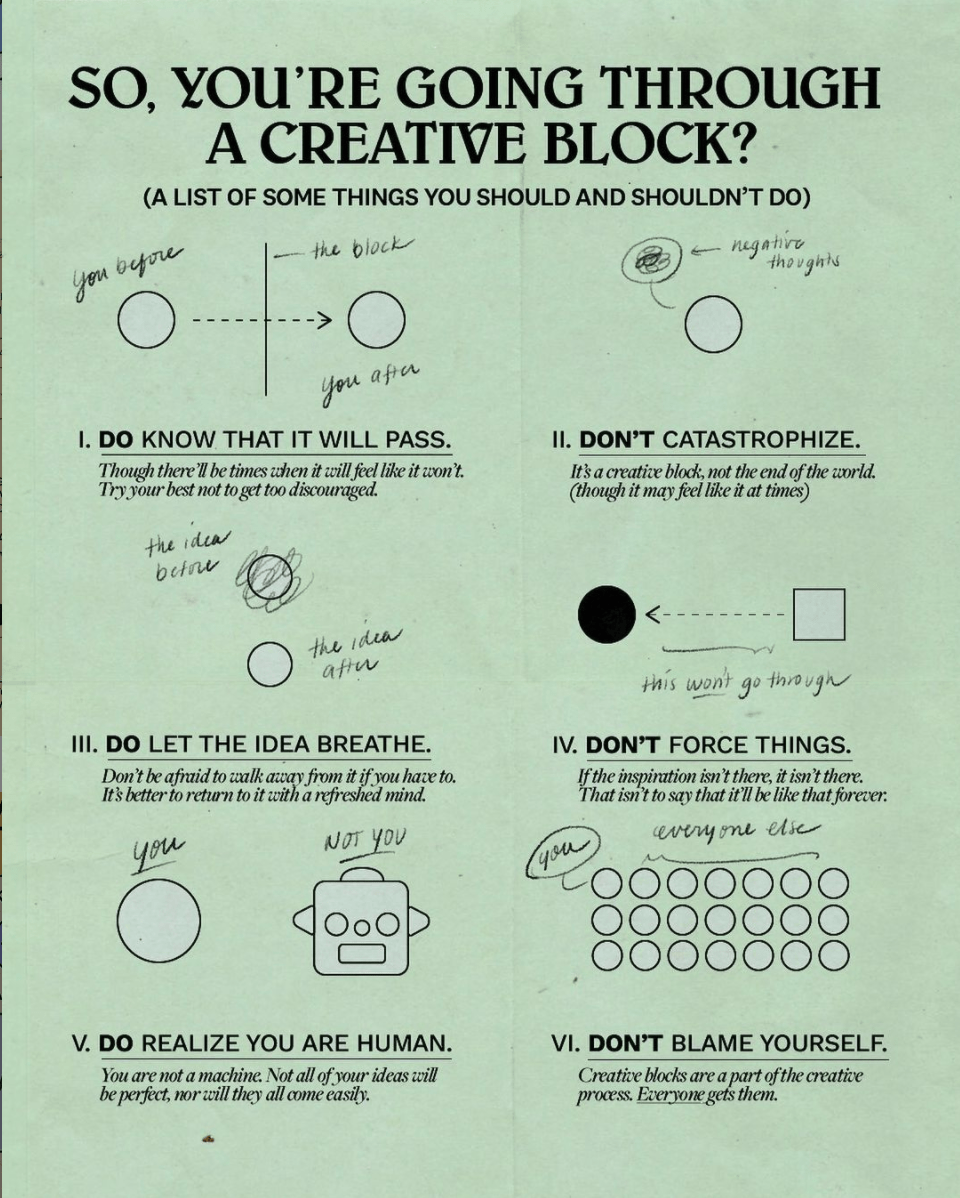
Many times, at the beginning of my creative process, I find myself staring at the blank page, feeling stuck and uninspired, not knowing where to start. It usually takes me around ten to fifteen minutes of stumbling words and hiccups to get in the flow and start rolling. You see, the way I experience entering the creative flow is a bit like a trail of domino pieces: Knocking down the first domino piece is always the hardest, but once you’ve given it a little push, the rest start to inevitably fall into place, one after the other. So I know that, once I push through that initial friction, the creative flow usually finds me on the other side.
Nevertheless, that said…
4. Don’t force things. Rest will take you places hustle never could.
What I mean is that being way too stubborn with your work and trying to force a creative spark that is not there will only end up being counter-productive.
You are not a machine nor a robot. You are a human-being and creative blocks are just a natural part of the creative process. We are taught and encouraged to hustle, but often forget that rest is also an essential part of work, and that it can be hugely beneficial to unleash our creativity and overall performance.
Therefore, it is also important to learn when you need to be patient and take a break from your work. Adding more pressure to yourself to further your creative process will only make your mind clench harder to the block you’re already submerged in.
Instead, try going for a walk, getting some fresh air, having a conversation with a friend, or taking a long shower. Anything that will make some space between you and your work, so that you can be exposed to new stimuli, and look at it with fresh eyes when you come back to it.
5. Explore and expose yourself to different disciplines.
If you’re at a point where your creative work feels empty – as if it’s losing its meaning, essence, or direction – it might be because you’ve been looking at it from a narrow-minded perspective for too long.
It can sometimes be a good idea to try to explore other disciplines. This could help you find interesting intersections between that new discipline and your own. Taking an element from one discipline and adopting it in another, could inspire you to create something completely new. Some of the most renowned polymaths like Leonardo Da Vinci, Galileo, or Darwin found their most important ‘eureka’ moments just like that. It requires paying attention to what surrounds us, looking further to what just meets the eye; admiring, contemplating, and observing closely.
You might also be interested in: Being a polymath and how to deal with it
6. Find or create the right setting.
The spaces where we create are important. Depending on their atmosphere, spaces can evoke different memories, feelings, and emotions, which can ultimately help spark your creativity.
If I’m writing, I personally like to surround myself with background noise (which is why I usually work best in coffee shops), but elements such as lighting, certain scents, or scenery can also incite my creativity and help me focus.
I also feel it’s important to find a spot where I can be comfortable, cozy, and where I know I will not be interrupted. A place where I can dedicate fully to create.
So, think to yourself, what is your ideal creative space? Does your current workspace inspire you? What are the elements (continuous interruptions, insufficient or wrong lighting, uncomfortable seating, noises…) that might be blocking you from entering the creative flow you are seeking?
Some people might find that an organized workspace helps them focus better on their creative endeavors, while others thrive in a cluttered space where they can be surrounded by objects, memos, books, or pictures that inspire them.
Whatever your preference, imagining and dreaming are the main vehicle to creativity, so make sure that you find the right environment to nurture that, free of constrictions, limitations, red lines, and hermetic boxes. And if you can’t find it… create it.
7. Use momentum, but don’t force creativity.
The same way creative blocks are a natural part of the creative process, there are also those days where we’re hit with sudden bursts of inspiration. Those times when new ideas seem to keep on knocking at your door. Days where your creative energy is at its highest.
On those sweet-sweet days, let the muse lead. Whenever you’re lucky to experience that creative kick, don’t let it slip. Embrace that positive inertia and start working on that idea right away, because that is exactly when your brain is already pumped-up with creative energy and ready to enter the flow. Use it to create momentum.
If for any reason, you can’t get started with it right away (let’s face it, sometimes our best ideas visit us in the most inconvenient moments), make sure to write it all down. Not just the idea itself but the feelings, the visualization, and the tiny details around the concept. You’ll have half of the work done with you’re ready to pick it up later.
8. Creativity is a muscle, exercise it often.
Creativity can be exercised in infinite ways – through imagination, play, experimentation, or even freeing specific creative time in your schedule. The more you put your creative element to test, the more it will evolve to work in your favor.
They say practice makes perfect. I’m not sure about perfect, but it is certainly a great lubricant for your creative thinking. In the end, great things are not so much accidental, as sudden bursts of inspiration can be, but more a series of small things brought together, that must certainly be willed.
So when it comes to creativity, even if it can’t be forced, remember it can always be encouraged.
Whether you decide to give yourself a break until you and your muse meet again, or decide to give a try to some of these tips to encourage your creativity instead, I hope you never stop doing what you love. I hope you never stop creating in a way that allows you to express yourself with honesty and authenticity.
It might not be perfect, and it might not be of everyone’s liking, but if it made you happy along the process, then it was exactly what it needed to be, and certainly worth it.
So tell the world who you are through your work. Leave the red tape, the doubts, and any expectations behind and start creating without inhibition once and for all.