

New Year’s Resolutions suck. There, I’ve said it. Don’t give me that look. You too, have probably experienced the frustration of starting the year fueled by the added burst of hope and motivation that one gets with the prospect of a fresh beginning and a blank slate… only to find yourself falling back into old patterns and not sticking to the promises you made to yourself. It’s discouraging, isn’t it?
But don’t worry, you’re not alone. In fact, did you know that from the 41% of Americans who made new year’s resolutions, only 9% were successful in keeping them? And that’s because New Year’s Resolutions are just not sticky. They lack a whole support system around them.
Anyone can make a list of goals and things they want to achieve at the beginning of the year, but the real challenge is actually sticking to them. Following through.
So, what if I told you that you are not the problem? The system you are relying on is.
What if I told you there’s a better way? One that will allow you to achieve long-term transformation, rather than just momentary change.
Let me introduce you to  systems
  and the step-by-step method that I am following this year to set the structure and focus for the upcoming months.
What are systems and who are they for?
To begin with, what are systems and who are they for? Why should they replace your good old resolutions list?
Systems are a combination of different rituals and habits that are integrated into your daily life in order to help you fulfill your intentions and design a lifestyle that aligns with your core values.
This method is particularly valuable for those who are…
- In need of a reset and an extra boost of motivation
- Finding it hard to find their focus
- Feeling lost, stuck, or in need of a more clear direction
- In need of some guidance to structure and plan the months ahead in order to experience sustainable and long-term behavioral change to support their big projects and goals, as part of a broader lifestyle transformation
Those big projects and goals can be anything from something as tangible as your creative passion projects or career development, to less palpable milestones such as wanting to improve yourself, healing, taking pressure off, being more productive, or prioritizing your mental and physical health, just to name a few.
If you want to work in any of these areas and really, truly, commit to them, you need a solid roadmap planned out that you can rely on.
That’s what systems are. They serve as a north star giving you a sense of direction. They remind you of where you are headed, and since they are rooted in an inward process that takes your core values and intentions into account, they also play a role in helping you discover yourself on the way.
As someone who is quite multi-faceted and has diverse interests, I can find myself stretching in many different directions, which causes my brain to go into overwhelm sometimes. I’ve realized that if I’ve got no clear structure, I can easily get lost in my mind’s clutter, become disperse, and it becomes more difficult to get things done.
If you can relate, then you also know how frustrating this can be.
Starting to work with systems as opposed to goals has personally helped me stay much more consistent and aligned with the type of habits and behaviors I want to create for myself, while giving me a greater feeling of progress and clarity.
Now I’d like to bring this framework into your life in hopes that you’ll experience the same thing.

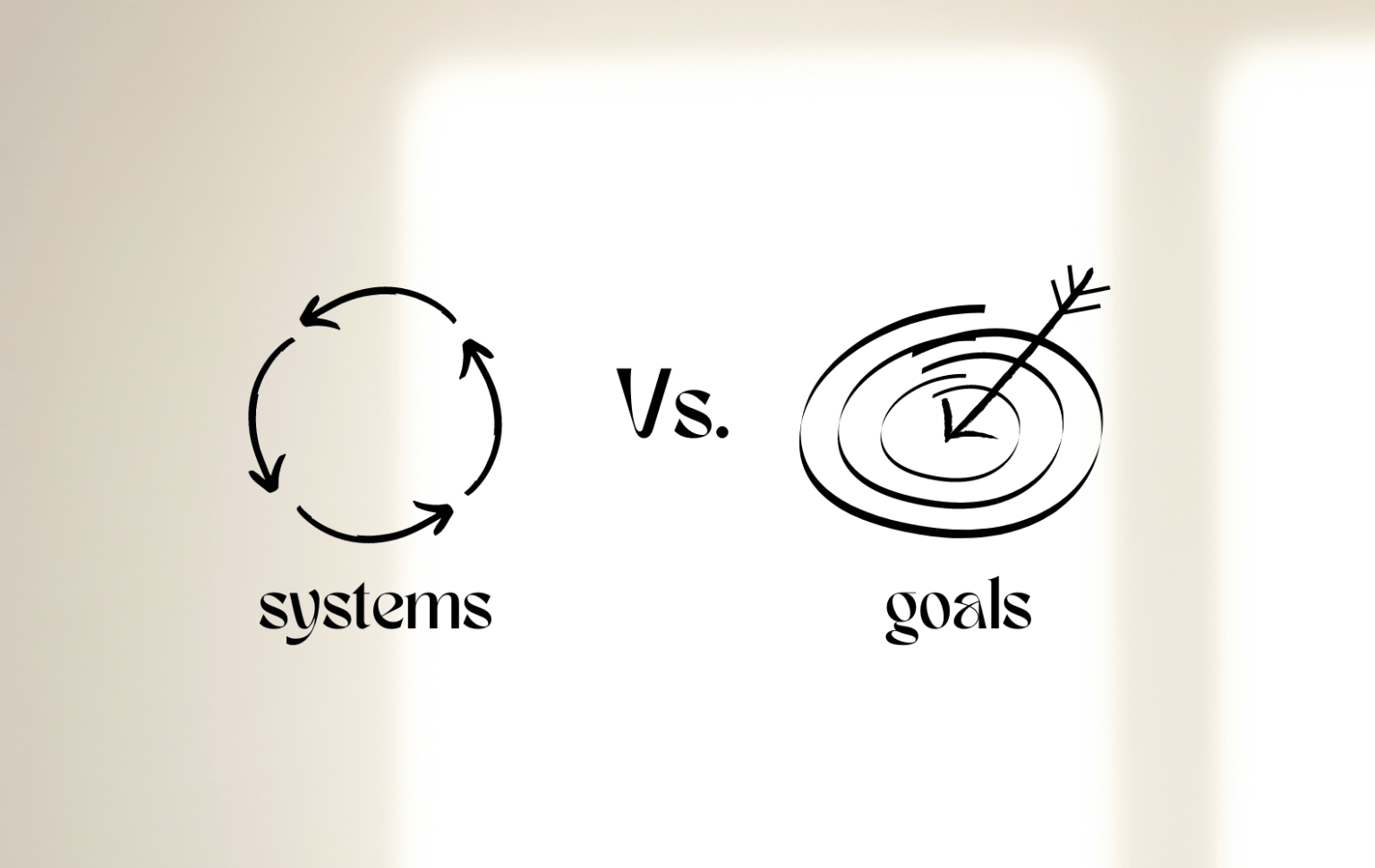
Systems Vs Goals
The essential difference between setting goals and systems is that goals are focused only on the end result, on the output. Whereas systems are focused on progress and the process or journey that leads to achieving happiness and wellbeing in the long run.
So whereas one focuses on creating a momentary change, the other aims to create a lifetime change.
The goal only cares about the end result; the performance. Whereas the system cares about the journey; the expansion process we undergo on our way to that result.
It might seem like a small difference, but it entails a complete change of mindset.
Building systems, or otherwise said, daily practices that you enjoy and are meaningful to you, means thinking long-term, in a sustainable way – which results in something absolutely key to achieving any broader goal: consistency.
However, that said, goals are an essential part of life design. They’re great in the way that they set a direction for us, and a good starting point to identify what our wants and desires tell us about who we are. But if we only think about the destination, and forget about enjoying the journey, we risk feeling drained in the process, getting fed up, and consequently giving up.
The key to not giving up.
When there’s intention there’s a clear and conscious ‘why’. That ‘why’ is the fuel that will push us further, because every time we are tempted to give up and our consistency is challenged, we can go back to that intention and be reminded of ‘why’ we set off on that path in the first place.
The good thing about intentions and systems, as opposed to goals, is that there’s more grace and flexibility to them. For example, if your goal is to run a marathon, and you give up halfway through your preparation, you’ll feel like you’ve failed. You either achieve your goal or you don’t. Goals are rigid that way.
Contrarily, if you work with a broader intention, such as to train your mind and body to become stronger, healthier, and lighter, less stressed…you can always work around it. If running doesn’t feel good anymore, if it’s no longer a motivating or attractive activity, you can still fulfill your intention by adjusting the medium and choosing to combine different types of exercises instead.
Let me illustrate what I mean with a personal example. Some years ago I remember that my motivation behind working out was mainly to ‘look good’ – whatever that means anyway… Although unconscious at the time, my goal was to lose weight and get a toned body.
The thing is, I struggled to stay consistent more than I do now, because deep inside, that wasn’t a good enough reason for me. It was much more linked to my ego than to a deeper purpose.
Whereas now, the force that drives me most to exercise and move my body is that I’ve realized how important it is for me to stay healthy so that I can feel strong and have the energy to do the things I love in the long run.
Before, perhaps I’d start working out in April just so that I could look better in a bikini in June, whereas now, I exercise and stay active because I want to keep this machine that I’m going to need for the rest of my life well-oiled up.
I’ve also become aware of how much it benefits my mental health and how it improves my mood and energy levels. And turns out, that has been a much better and stronger WHY for me, making it much easier to stay consistently active in my day-to-day. My brain remembers that feel-good feeling I get after a good run or going on a long walk.
Long story short, be mindful of your ‘WHY’s’ when setting your goals and intentions, and reevaluate them often because that’s how impactful they are when it comes to achieving sustainable change.
How to build your own systems
Now that we are clear on what systems are, and how they can help, let’s see how we can build our own in a practical way that can be directly applied to our day-to-day lives.
We could break down systems into four different layers: Intentions, Mindset, Goals, and Actions.
1. Intentions
Intentions are the base and foundation of any good system. As mentioned above, they’re the powerful WHY behind the actions you engage with. Defining them is an inward process deeply linked to analyzing your values and the pillars of your life that you find most important, and should therefore trigger introspection.
The ultimate question you are trying to answer along this process is “Results aside, what am I trying to achieve?” which is deeply linked to the identity that you want to embody.
When setting intentions, remember that they should be:
- Framed as a positive affirmation (e.g.: “I AM” strong/ free/ committed / physically active/ financially stable etc.)
- On the back of a wider goal
- Part of small rituals that you can set on a regular frequency
2. Mindset
Our mindsets are a powerful differentiator for how we live our lives. Through a set of self-perceptions and beliefs, they determine our behavior, outlook, and mental attitude.
This means we won’t ever rise above the opinion we hold about ourselves. Our self-image and self-perception become the threshold we live up to. And so if we wish to grow, improve and expand ourselves, we must first work on growing, improving, and expanding our mindset so we can step out of the limiting beliefs that our fixed mindset holds us hostage to.
In the end, it all boils down to the beliefs we hold about ourselves. Whether we’re aware of it or not, these beliefs are deeply ingrained in our minds and we operate on them to go on with our daily tasks and activities, which is why they are so determinant to our success (whether it’s in our relationships, career, personal financing, creative endeavors and so on).
So, how do we reprogram our minds then? How do we build a strong, optimistic, and resilient growth mindset that will support us in following through with these systems we want to embark on?
Read more: Do you have a fixed or a growth mindset? Here’s how to make the shift.
It all starts with becoming an observer of your mind.
The first step is to identify your fixed mindset beliefs (that annoying little voice in your head who’s a bit of a bully and tries to hold you back).
Secondly, you have to look it directly in the eyes, and say “You know what? You’re wrong”. And reframe it.
For every limiting thought and belief that pops up, be ready to counter-attack with something uplifting, positive, and inspiring. Think, what would you like to tell yourself instead? Write it down right next to the negative thought that is sourced from insecurity and fear so you can see them side by side. It will help you bring some perspective into your thinking.
Engaging in this exercise frequently, whenever self-doubt starts to creep in, will help you identify the inner chatter that keeps going on in your head and work towards reprogramming it.
→ Here’s more on why journaling and writing things down is a much more powerful way to transform our neuro-pathways than just trying to reframe those thoughts in our heads.
Lastly, how can you put this into action?
Because you’re right. Writing down the positive beliefs and thoughts that you’d like to cultivate won’t magically install them in your head. A change of mindset is not like a change of clothes. It’s more like a change of style. It’s something that must be consciously and consistently refined time and time again.
In that sense, it’s important to realize that our minds are significantly influenced by the environments that we are in constant touch with. Think for a second, are you exposed to uplifting thoughts, people, and environments that fuel your growth? Or could your environment be playing a part in some of the limiting behaviors that hold you back?
Our mind becomes what we feed it. Seek to proactively nourish it with recipes for growth. Dynamics, culture, ideas, affirmations, conversations, and educational content will help build a growth mindset. One that frequently whispers ‘I can. I will’.
3. Goals
Why do our brains like setting goals so much?
Goals are a practical, and tangible way to design and see our future. They’re a part of the cognitive process of planning and analyzing. They help us in the process of visualizing how we are going to get from A to B. And our brains love that.
Each time we engage in this process, our brains actually reward us with feel-good hormones such as dopamine, so it’s no surprise that people love setting new years resolutions so much. Visualizing your next big destination is energizing and feeds us with hope.
So, let me ask you now – Where are you planning to get to? What are those tangible destinations you’d like to get closer to this year? Write them down in a list. Maybe even divide them by categories like your career, relationships, health, finances, personal growth, learning new skills, expanding your circle, engaging in new activities or places… anything that drives you, anything that gets you excited.
Now take a moment to vividly visualize yourself achieving each and every one of those goals. Feels great?
Well, besides offering that feel-good sensation, visualization is also a powerful exercise to help you build upon that growth mindset we mentioned before. It boosts your confidence and trust in achieving that dream and enhances your motivation.
Regularly visualizing yourself achieving your goals can be extremely helpful in the process of actually achieving them.
Have fun entertaining the possibility of getting there and stimulating your imagination. Because before you achieve any goal, you first need to be capable of believing you will get there, and envision yourself as eventually succeeding.
4. Actions
At this point in the process, we’ve got a clearly defined destination. It’s challenging, exciting, and somewhere we know we can get to. We’ve visualized ourselves there and we know we can make it happen. Great.
However, we also know, that that’s not enough. It’s also important that we define the daily actions and habits that will help us get there while being mindful of the triggers and patterns that might keep us from sticking to them.
And that’s actually the very last layer of our system-building or pyramid. Defining actions and creating habits.
Systems are built up by the habits we’ve defined after aligning them with our goals, intentions, and values. Remember, habits are those little rituals that we repeatedly do over and over again. And our true power is on whether we choose the ones that are destructive OR those which help us evolve. And notice I said choose. Because it’s in that choice where this positive growth and transformation we are looking for lies.
If there’s no conscious choice, no intention, it’s easy for our minds to just operate on autopilot, and fall back into old patterns, doing whatever is easiest, or lowest effort for us, which as we already know, doesn’t usually come with the best outcomes. So again, choice is a key element in habit-building. Choosing them over and over again on a regular basis.
In the end, these small routines and behaviours will accumulate to produce incremental and positive improvements in our lives. You’ll finally know you’ve built a habit when something becomes repeated enough times that it becomes automatic, almost effortlessly.
However, I’ve gone through enough trial and error to know that there’s nothing ‘effortless’ about habit-building. At least not at the very start. Building habits is no easy feat, it’s actually more of a complex science.
Which is why I’ve compiled these easy-to-use worksheets to help you build your own personal plan and systems.
Whether you’re looking for a fresh start, some guidance to structure & plan the upcoming months, or simply need an extra boost of motivation to keep going forward in your growth journey, these worksheets will help you build an intention-based system for long term transformation rather than just momentary change.
Say goodbye to non-sticky new years resolutions  This very moment is as good as any to re-set, re-align, and re-evaluate our priorities & habits (no need to wait for the beginning or end of a cycle!)