

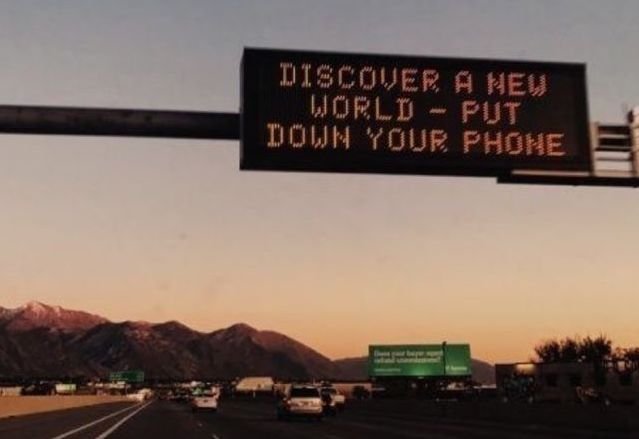
There are many things that differentiate us from others and make us diverse as individuals, but if there is something that we all have in common, that is definitely the way we are completely absorbed by our devices.
Why do we all live so obsessed with our screens? On average, we unlock our phones 150 times a day.
And tap, swipe, and click on our phones 2,617 times per day.
That is insane. And I don’t mean just crazy, but ‘not sane‘ in the most literal sense of the word.
If that doesn’t freak you out I don’t know what will. I definitely find it concerning, despite (or maybe because) I am an avid phone user myself, heavily relying on these devices not only for work but also to fill my personal time.
However, I didn’t have to look up these stats to know that I’ve been doing an excessive use of my phone for some years now.
And I am pretty sure you have been too.
Don’t get me wrong, I am not out to get you, but if you’re a 90’s kid, or came to the world any time after that, then you’ll agree that we were basically born with this device in our hands.
The issue is that, over the years, the use of these devices has had exponential growth, to a point where they have completely taken over our lives. Not to mention that smartphone usage increased 70% worldwide due to the coronavirus outbreak this year alone.
Being stuck at home, the alternative in terms of accessibility to information, entertainment, people, and any sort of relationship came through our screens. But the pandemic was just the last straw, because we were already heavily relying on them much before that.
Need to do your groceries? Get a doctors’ appointment? Take notes? Solve an easy equation? Meditate? Feeling alone? Need a friend? A partner? Don’t worry, there’s an app for that!
These days, there’s an app for everything.
WE HOLD OUR PHONES IN THE PALM OF OUR HAND, BUT IT IS THEY THAT HAVE US IN THEIR GRASP –
Robert Poynton, Author of “Do pause: you are not a to-do list”.
But we know.
Deep down, we are aware of the power and influence that these devices have over our lives, and the negative impact that they can have on our energy levels and overall well-being. However, we choose to ignore them the same way people choose to ignore that smoking or shoving highly sugary sodas down their throats every day is harmful in the long term. Even worse, we fool ourselves into thinking that “we can quit whenever we want to”.
But the truth is that most of us have developed a relationship of dependency with our phones over the years (let’s not make anyone uncomfortable by calling it ‘addiction’ though).
The tricky thing about addiction is that no matter the substance, it convinces you that you’re okay while subtly sucking the life force right out of you.
You’re probably familiar with that unique feeling of anxiety you get when you can’t find your phone in your pocket. Nothing close to the one you get when you lose your keys, right?
73% of people surveyed in a Harvard study agreed they had experienced high anxiety levels due to losing their phones. 25% of adults wake up to use their phones at night. 33% of teens bring their phone to bed. 75% of Americans use their mobile phones on the toilet.
And if I am honest, although I am no longer a teen nor an American, they could very well add me to any of those startling stats too.
What about you? How often does your smartphone leave your side on a regular day? How often do you check your phone while being with friends and family? How much longer does it make you stay up at night? How many times has a notification on your screen made a click on your mood?
Whether we are sufficiently aware to admit it or not, we are quickly becoming a generation of addicts who are often more focused on what happens on our screens than in the world around us.
How has this little device that fits in the palm of our hands gained this level of influence over so many areas in our lives? Nowadays, your phone is everything. Your alarm clock, your calculator, your GPS, your way of getting around and communicating, your primary source of information, your storage unit, your agenda, your dictionary, your showroom, your radio, your loudspeaker, and not just your teacher but your master.
This is why it accompanies us through every minute and every hour of the day, offering us an unlimited source of content, with the promise of filling any empty space in our lives. We are being exposed to constant overstimulation since our very early days and have now become uncomfortable with the lack of stimuli. We crave them just like any junkie would crave their fix.
One of the examples that illustrates this best is waiting times.
Do you ever see people waiting for someone just ‘being there’ anymore? You know, just standing and looking around, instead of down at their phones? I rarely do.
And despite being constantly connected, plugged in, studies show that people have never felt so alone. Phones have brought us closer to people who are far away from us, but have created distance with those who are sitting right next to us.
So, what do we do then? Get rid of our phones? Uninstall all the apps? Rewind to viking horn times?
Well, I believe there’s no need for such drastic measures. Things are never black or white, and let’s face it, being connected still brings plenty of advantages to our lives. Smartphones are incredible tools that help us make numerous tasks smoother and more convenient. However, depending on the use we make of them, they offer us two paths to take: one that can enhance our lives by using them as a great tool for productivity, connectivity, and education, or the other, which can turn into the biggest distraction of our lives.
I believe that the thin line that marks the difference between those two paths is measure.
Because the issue is not the fact that we use these devices, rather how and how much we use them.
The real problem comes when we never disconnect. When we don’t know where to draw the line. When we never log out. When we never pull the switch.
I believe there is an urgent need for greater balance, and I don’t think I speak just for myself when I say that, but rather for my whole generation and the ones that come after us. If we don’t learn to put space between ourselves and our devices we risk becoming an abstract, distracted, and impatient generation that has completely lost touch with reality. We risk living in a delusion where we think that the most important things in life happen on our screens rather than outside of them.
But we can decide to take back control and learn to put technology to our service rather than the other way around. The challenge is to make these devices work for us, instead of against us.
So as someone who has identified inappropriate and excessive use of these devices in my own personal life I have decided to take action in order to transform the relationship I have with my phone and the amount of influence it has over my energy and time on a daily basis.