


Nearly 57% of Americans can’t cover an unexpected $1,000 expense without borrowing money, according to Bankrate’s annual emergency savings report. Yet many of those same people knew certain large costs — a car repair, a holiday, a home insurance payment — were coming months in advance. That’s exactly the problem sinking funds solve.
Whether you’re managing a personal budget or running a business, sinking funds are one of the most effective financial tools you’ll ever use. By the end of this guide, you’ll know exactly what a sinking fund is, how it works, where it fits in both personal and business finance, and how to set one up starting today.
What Is a Sinking Fund?
A sinking fund is money you set aside in small, regular amounts to cover a specific future expense. You know the expense is coming. You know roughly what it will cost. So you start saving for it now, in advance, rather than scrambling when the bill arrives.
The name sounds alarming — nothing is actually “sinking.” The term comes from old accounting language, where “sinking” meant reducing a debt or obligation over time. Think of it less like a ship going under and more like a slow, steady countdown toward a goal.
Here’s the simplest way to picture it: you know your car registration costs $300 every year. Instead of panicking in December, you save $25 each month. By the time December arrives, your $300 is already sitting there, ready to go.
How Does a Sinking Fund Work?

A sinking fund works by breaking a large future cost into smaller, manageable pieces spread across time. You pick a target amount, set a deadline, do the math, and save that fixed amount every month — or every paycheck.
The process looks like this: divide your target amount by the number of months until you need it. That’s your monthly contribution. You save that amount consistently, and your fund grows until you reach your goal right on schedule.
For example, say you want $1,200 set aside for holiday gifts and travel in December. If you start in January, that’s 12 months away. You’d save $100 per month, and by December, you’ll have exactly what you need without touching a credit card.
Sinking Funds in Personal Finance
In personal finance, sinking funds are savings buckets you create for known, irregular expenses. These are costs that don’t show up every month but hit you hard when they do.
Common personal sinking fund categories include:
- Car maintenance and registration — tires, oil changes, registration fees
- Home repairs — HVAC servicing, appliance replacement, roof maintenance
- Medical and dental costs — planned procedures, deductibles, copays
- Annual subscriptions — software, gym memberships, streaming bundles
- Travel and vacations — flights, hotels, spending money
- Holiday gifts and celebrations — Christmas, birthdays, anniversaries
- Back-to-school expenses — supplies, clothes, activity fees
- Pet care — vet visits, grooming, boarding
You don’t need a sinking fund for every category from day one. Start with your two or three biggest irregular expenses and build from there. Once you’re ready to add sinking funds to your monthly budget, you’ll see exactly where each fund fits within your overall spending plan and how much room you genuinely have to contribute each month.
Sinking Funds in Business and Corporate Finance
Sinking funds aren’t just for personal budgets. In the business world, they serve a specific and important function: helping companies pay off debt or replace major assets over time without a financial shock.
When a company issues bonds — essentially borrowing money from investors — it sometimes creates a sinking fund to gradually set aside cash so it can repay those bondholders. Rather than owing one massive lump sum at maturity, the company chips away at the debt over the life of the bond. This lowers the risk of default, which is why bond rating agencies view sinking fund provisions as a sign of financial discipline.
According to the Corporate Finance Institute, sinking fund provisions can make corporate bonds more attractive to investors because they reduce credit risk over time. A company that proves it’s systematically setting money aside is considered a safer borrower than one that isn’t.
Businesses also use sinking funds for capital expenditures — replacing company vehicles, upgrading equipment, or renovating facilities. A manufacturing company that knows its machinery has a 10-year lifespan, for example, might start a sinking fund from day one so the replacement cost is already funded when the time comes.
Sinking Funds in HOA Finance
Homeowners associations use sinking funds — often called reserve funds — to prepare for large-scale property repairs and replacements. This is one of the most common real-world applications you’ll hear about, and it affects millions of Americans who live in condos, townhomes, or planned communities.
An HOA sinking fund might cover things like repaving the parking lot, replacing the roof on a shared building, resurfacing the pool, or updating elevators. These are predictable, expensive projects that a well-run HOA plans for years in advance.
When an HOA is underfunded, it has two options: issue a special assessment (an unexpected bill to homeowners) or take out a loan. Both are painful. A well-funded sinking reserve protects homeowners from those surprises and keeps property values stable.
The National Reserve Study Standards recommend that HOAs conduct regular reserve studies to estimate future repair costs and calculate exactly how much to contribute each year. Buyers often check an HOA’s reserve fund health before purchasing a property — a thin reserve fund is a red flag.
Sinking Fund vs. Emergency Fund: What’s the Difference?

Many people confuse sinking funds with emergency funds, but they serve very different purposes. Knowing the difference helps you use both more effectively.
| Feature | Sinking Fund | Emergency Fund |
|---|---|---|
| Purpose | Known, planned future expense | Unknown, unexpected crisis |
| Timeline | Set deadline | No set timeline |
| Amount | Specific target | 3–6 months of expenses |
| Examples | Car registration, vacation | Job loss, medical emergency |
| Mindset | Expected and intentional | Protection against the unknown |
Your emergency fund is your financial safety net for true surprises — a job loss, a sudden illness, a flooded basement. Your sinking fund is your preparation tool for costs you already see coming.
Think of it this way: if your car’s check engine light comes on and you have a sinking fund for car maintenance, you dip into that. If your car gets totaled in an accident and you lose your income the same week, that’s what your emergency fund is for.
Both funds can — and should — exist at the same time. They’re not competing. They’re complementary.
Sinking Fund vs. Savings Account: Are They the Same?
A sinking fund is a purpose and a plan. A savings account is a place to store money. They’re related, but they’re not the same thing.
You absolutely can keep a sinking fund inside a regular savings account. Many people open separate savings accounts for each sinking fund category at their bank or credit union. Others use high-yield savings accounts to earn a bit of interest while their fund grows.
The key difference is intention. A general savings account might hold money with no specific goal attached. A sinking fund always has a defined purpose, a target amount, and a target date. That clarity is what makes it work.
Some banks like Ally, Capital One, and SoFi let you create multiple savings “buckets” or “goals” within one account, which makes managing multiple sinking funds much simpler. You can also track your sinking funds inside budgeting apps like YNAB or EveryDollar, which treat them as dedicated spending categories.
How to Set Up a Sinking Fund in 5 Steps
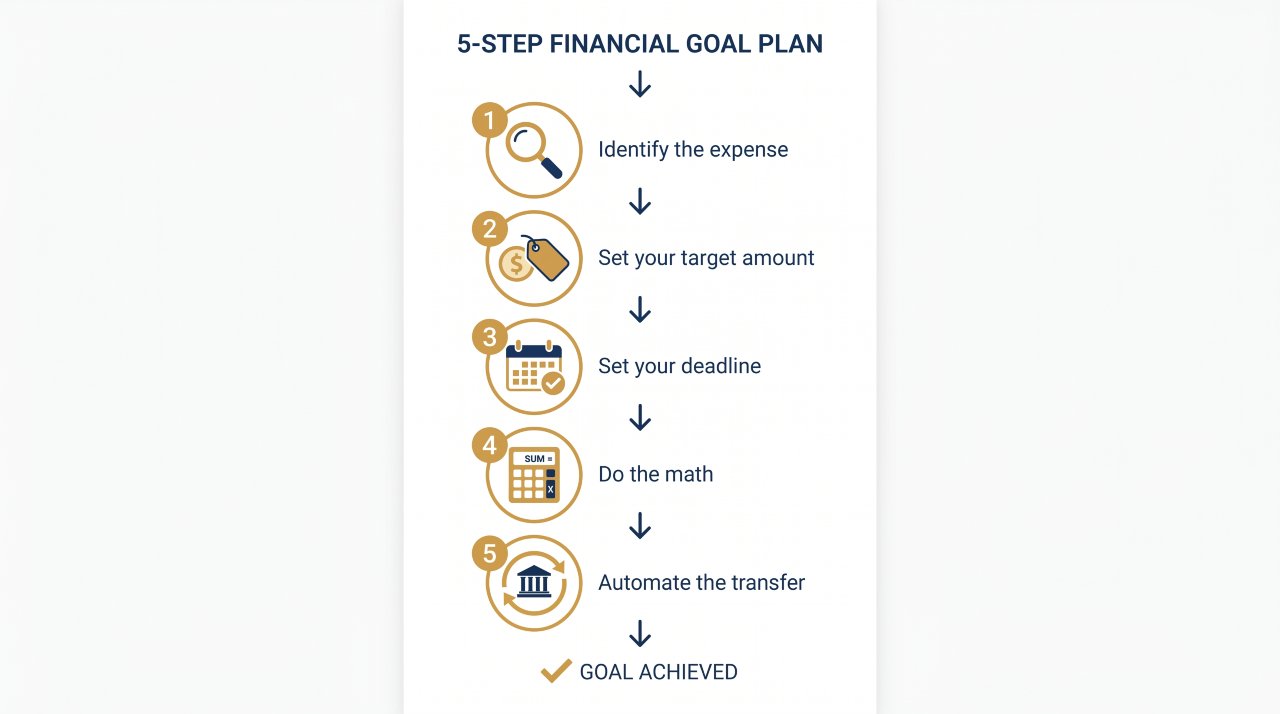
Setting up your first sinking fund doesn’t require any special accounts or software. You can start with a notebook, a spreadsheet, or your current bank account.
Step 1: Identify the expense. Pick one specific upcoming cost you want to prepare for. Be concrete — “car costs” is too vague. “New tires: $600” is a sinking fund target.
Step 2: Set your target amount. Research the actual cost. Get a quote, check past receipts, or estimate conservatively. It’s better to save a little more than to come up short.
Step 3: Set your deadline. When do you need the money? A specific month works better than a vague “sometime next year.” Count the months between now and then.
Step 4: Do the math. Divide your target by the number of months. That’s your monthly contribution. If $600 ÷ 6 months = $100/month, you’ll set aside $100 starting now.
Step 5: Automate the transfer. Set up an automatic transfer on payday so the money moves before you can spend it. This removes willpower from the equation entirely.
You can run multiple sinking funds at once. Most people who budget intentionally maintain between three and eight active sinking funds simultaneously. Pair your sinking funds with saving strategies that work alongside sinking funds to accelerate how quickly you hit each target — especially if you’re starting with a tight monthly surplus.
The Real Benefits of Sinking Funds
Sinking funds do more than just save money. They change how you relate to your finances entirely.
You stop dreading predictable expenses. When you know your $1,800 vacation fund is already built up, the trip feels earned rather than stressful. You don’t come home to credit card debt.
You borrow less. Every dollar you save in advance is a dollar you don’t borrow at interest. According to the Federal Reserve’s consumer credit data, the average credit card interest rate in the US sits above 21%. A sinking fund that replaces one $1,000 credit card charge saves you $210 or more annually in interest alone.
Your budget gets more accurate. Irregular expenses are one of the biggest reasons budgets fail. When you account for them in advance, your monthly numbers stop lying to you.
You make calmer financial decisions. When money is already set aside for a specific purpose, you don’t panic. You don’t rush. You make better choices.
Honest Limitations of Sinking Funds
Sinking funds work beautifully when the plan goes according to schedule. But a few limitations are worth knowing.
Costs can be unpredictable. You might budget $500 for car repairs and face a $900 transmission bill. A sinking fund reduces the sting, but it doesn’t always eliminate it. Build in a 10–15% buffer when you can.
They require consistent contributions. If you miss months due to a tight cash flow period, your fund falls behind. Life happens, and that’s okay — but sinking funds reward consistency above all else.
Managing too many at once can feel overwhelming at first. Start with two or three and add more as the habit becomes second nature. Don’t create eight sinking fund categories on day one and burn out before the system takes hold.
Frequently Asked Questions
What is the meaning of sinking fund?
A sinking fund is a dedicated savings account or bucket of money you build over time to cover a specific, known future expense. You contribute a fixed amount regularly — weekly, biweekly, or monthly — until you reach your target. The term originates from business accounting, where it refers to money set aside to retire a debt.
What is a sinking fund example?
A common example: you know your home insurance renews every December for $1,200. Instead of paying it all at once from your monthly budget, you save $100 every month starting in January. By December, you’ve got the full $1,200 waiting without touching a credit card or emergency fund.
What is a sinking fund in HOA?
In an HOA context, a sinking fund — often called a reserve fund — is money the association collects from homeowners over time to pay for large future property repairs or replacements. This might include repaving roads, replacing roofs, resurfacing pools, or updating shared systems. A healthy HOA reserve fund protects homeowners from unexpected special assessments.
Is a sinking fund the same as a savings account?
No, though you can keep a sinking fund inside a savings account. A savings account is a financial product. A sinking fund is a strategy — a purposeful, goal-specific savings plan with a defined target amount and timeline. You could have multiple sinking funds stored in separate savings accounts, or in labeled buckets within a single account.
How is a sinking fund different from an emergency fund?
An emergency fund covers unexpected crises you can’t predict — job loss, sudden illness, or major accidents. A sinking fund covers known future costs you can predict and plan for. You need both. They serve different purposes and should not be mixed together.
Is a sinking fund a good idea?
Yes, for most people and most situations. Sinking funds reduce financial stress, help you avoid high-interest debt, and make irregular expenses manageable. The only scenario where they’re less useful is when cash flow is so tight that you genuinely can’t set anything aside — in that case, focusing on stabilising income or reducing expenses comes first.
The One Thing You Should Take Away
Sinking funds are simple, proven, and massively underused. The concept is straightforward: you save small amounts now so you don’t get caught off guard later. That’s it.
Whether you’re preparing for a holiday trip, building reserves as a small business owner, or contributing to an HOA, the principle stays the same. Know what’s coming. Calculate what you need. Save consistently. Use the money when the time arrives.
Your next step: Pick one upcoming expense you know is coming in the next six to twelve months. Calculate exactly what it will cost. Divide that number by the months you have. Then set up an automatic transfer for that amount starting on your next payday. That’s your first sinking fund — live and running.